Pocket Spring vs. Bonnell: How Do These Coil Mattresses Differ?
Pocket springs never touch each other, so rolling over won't disturb your partner, there's no metal squeaking, and they support the spine ergonomically. Traditional interconnected coils are firmer and structurally the most durable — favored by hotels and by people who grew up on, or prefer, a hard bed.
Structurally, both are innerspring mattresses; historically, the pocket spring came along as an innovation after the interconnected coil. Here's a quick introduction to each:
Traditional interconnected coil mattresses

- Traditional interconnected coils use small helical wires to link every spring together into a single spring web.
- Also known as a 'firm spring bed' or 'traditional innerspring,' this build offers stronger support but less give and a higher firmness level. It suits people who are still growing or who are used to sleeping on hard beds, and is less suitable for light sleepers or anyone worried that turning over might disturb their partner.
Pocket spring mattresses
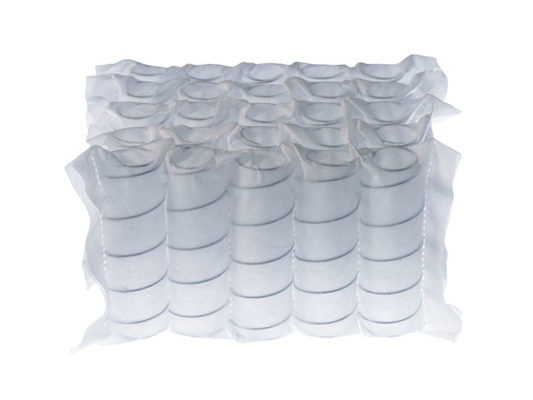
- Partners are far less likely to disturb each other
- The springs never touch, so there's no metal-on-metal squeaking
- Ergonomic by design: they properly support the weight of different body zones, helping keep the spine in a straight line and the body relaxed
- By arranging pocket coils with different individual properties, they can meet the needs of different body shapes and builds
That said, how well any mattress performs still comes down to its overall design. It isn't a matter of simply adding or removing layers — letting each material do its job properly is what real value for money means.
In terms of pure structural strength, the traditional interconnected build is unquestionably the most durable: because every spring moves the whole web, the connected structure spreads out point loads and eases the pressure on each individual spring. Look closely at commercial venues — hotels, motels, resorts, or anywhere offering a short stay — and you'll find they mostly use interconnected coils, because in those settings a mattress is a consumable: guests with all sorts of habits use the beds in all sorts of ways, so wear and tear runs high. Rooms fitted with pocket spring mattresses also tend to cost more — a premium that offsets the consumable; a special experience comes at a special price.
Designing mattresses is an art, but we remain craftsmen, not doctors — we can't offer you health guarantees. What we can do is recommend the mattress that fits your particular needs. In the end, you have to lie on it yourself to know. If you're in the market for a mattress, you're very welcome to visit one of our stores and try them out!
FAQ
Which is more durable — pocket springs or a traditional innerspring?
In terms of structural strength, the traditional interconnected design is the most durable. Because the springs are linked and move as one, the structure spreads out point loads and reduces stress on individual coils — which is why hotels and motels, where mattresses are consumables, mostly use interconnected coils.
Which type suits light sleepers who wake when their partner rolls over?
A pocket spring mattress. The coils don't touch one another, so partners rarely disturb each other and there's no metal-on-metal squeaking. The springs also support each body zone ergonomically, helping keep the spine aligned and the body relaxed.
Who are traditional interconnected coil mattresses for?
Also called firm spring beds or traditional innersprings, they offer strong support but less give and a higher firmness level. They suit people who are still growing or who are used to sleeping on hard beds — and are less suitable for light sleepers or anyone worried about disturbing a partner when turning over.